Rome Journal

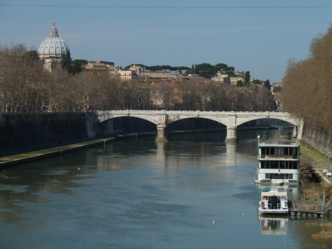
As you cross the Ponte Sisto, looking north you can see the dome of St. Peter and the next bridge, Ponte Mazzini.
To the south of the Ponte Sisto, you gaze upon the Ponte Garibaldi. Behind it, you can see an island dividing the river, the Isola Tiberina, where there is an old hospital—and once a Temple of Asclepius, the god of medicine.
Peregrinations
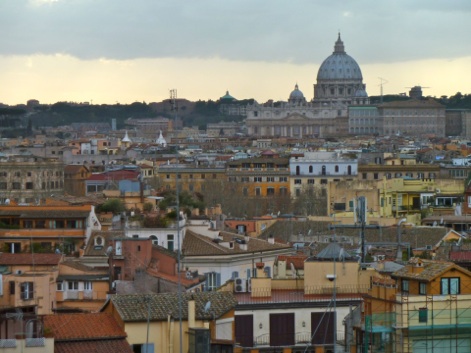
The welcome tourist. Rome has been a mecca for travellers for so long that I am sure my arrival was no occasion for surprise. There are few places where being a “tourist” is more appropriate; indeed, the fault would lie in not making the trip. It’s a place that seems at ease with being the centre of attention.
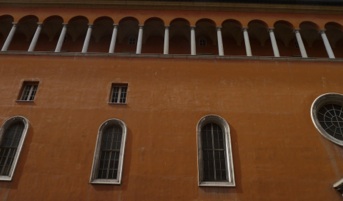
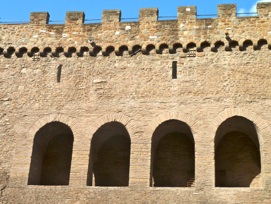
“Ancient footprints are everywhere...” goes the Dylan song. The picture of the wall on the left surrounding the Vatican details a design that is seen in a more recent building. Wandering through these living archives it’s hard not to pick up on the historical “static”: ancient themes whisper like eerie ghosts from one age to the next, producing an almost architectural claustrophobia. “The streets of Rome are filled with rubble / Ancient footprints are everywhere....” It is a city of decay that resists ruin. “You can almost think that you’re seein’ double / On a cold, dark night on the Spanish Stairs.”
The Mediterranean
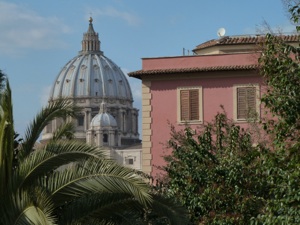
It’s a different palette. More pastels. Tuscan browns. Palm trees! A lot of stone. And some of the most stunning blue skies at twilight. Ultramarine. Or Pythlo blue. Mental blue.
Trastevere
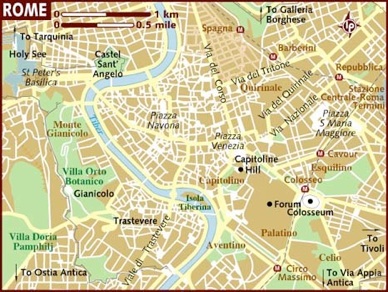
The area where I had rented a place to stay. It’s an old working class district that has since been gentrified or at least become more of a magnet for tourists with endless narrow streets of restaurants, shops and bars. The district is about a 10-minute walk to the Centro Storico across the Tiber River and about a 30-minute walk to Vatican City.
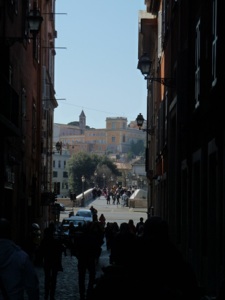
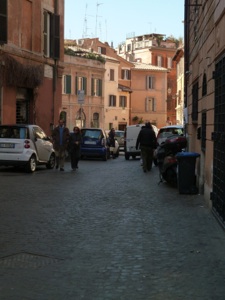
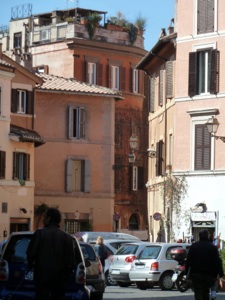
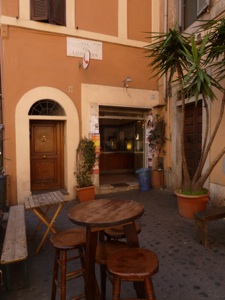
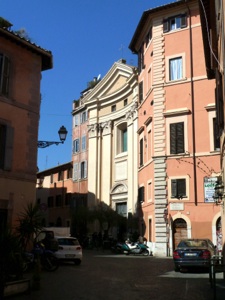
This is Via dei Santa Dorotea, looking westward (or is it northward?) toward the building where I rented a first floor studio apartment. Traffic is restricted in these historical areas, meaning you pay a premium or toll for driving through. My building is the reddest one in the picture below left.
When you walk out of the building where I stayed, this pizza patio (in the photo on the right) is the next street number. Every day they had a selection of about a dozen or so different types of pizza slices, all garnished with fresh foods. For 5 euro, you could get a beer and a couple of small slices...in seconds.
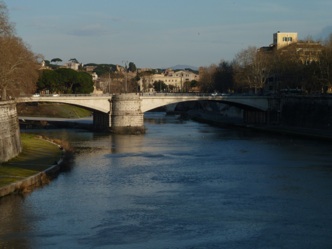
If you turned around on Via dei Santa Dorotea in the direction opposite from a few photos above, you’d almost be at the Ponte Sisto—the sweetest bridge in Rome. It is a walking bridge that connects the Trastevere to the Centro Storico. The snapshot on the left looks back over the bridge toward Trastevere.
Centro Storico
Once you cross over the Tiber from the Trastevere district, you enter the area known as the Centro Storico—a labrynth of what I would call Shakespearean streets and alleys, not just because of their vintage but also because of the intrigue they spark in one’s imagination.
The first view to take me aback: the Chiesa di Santa Barbara dei Librari—on the right. The façade is the only actual wall of the church. It was built into one of the vaults under the cavea or semi-circular seating areas of the Theatre of Pompey sometime before 1100 A.D., possibly as early as the 10th century. In 1601 it was granted to the “sodalizio dei librai,” a guild of printers, bookbinders and scribes that had formed the year before. For a period of time, it was called the “S. Barbara Anglorum” on account it served for a period as the church for the British Catholic community in Rome. The current exterior is the design of painter and architect, Guiseppe Passeri, from 1680. There are over 900 churches in Rome.
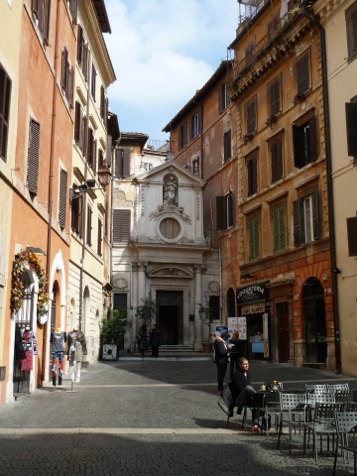
Santa Barbara
(3rd Century A.D.?)
Daughter of a rich heathen, Dioscorus, who kept her shut up in a tower in order to “preserve” her for the right marriage. She rejected his choice of groom for her and confessed her Christian belief. Her father dragged her before the Roman prefect of the province, Martinianus, who had her tortured and then beheaded—the father carrying out the sentence. On his way home from the execution, Dioscorus was struck by lightning and consumed.
S. Barbara is thought to protect people from thunderstorms and fire and is now also the patron saint of artillery-men, bomb-disposal experts, miners, fishermen...anyone who risks sudden death. She is also the patron saint of the Italian Navy. Huh.
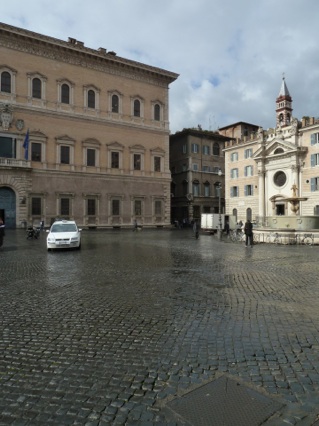
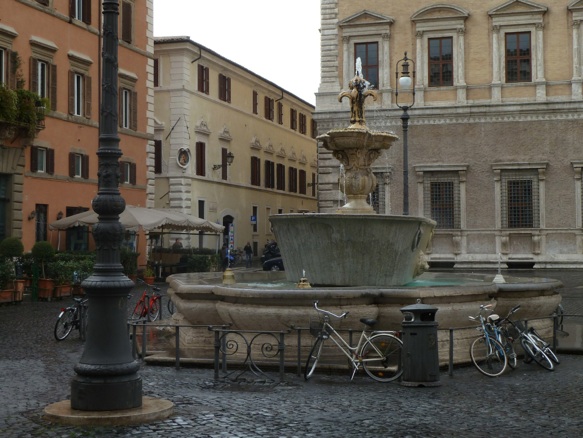
Piazza Farnese
The Piazza Farnese is one such oasis. A large square of cobblestone fronting a palace now serving as the French embassy and the École Française de Rome. It is the palace in which Puccini unleashed the Chief of Police, Scarpia, upon his heroine, Tosca.
STREETS OF ROME
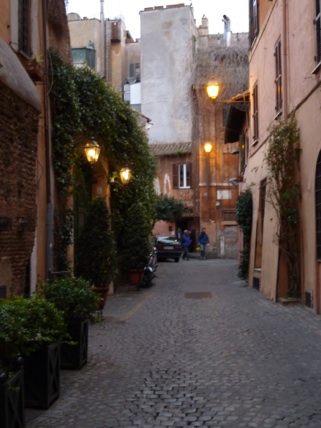
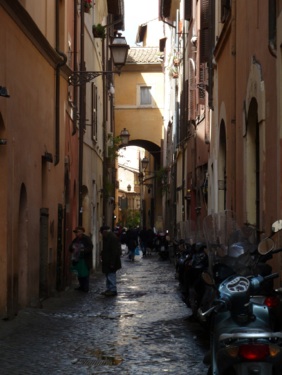
It is the city to get lost in...with no regrets. You wander round and about, vaguely guided by what usually turns out to be a false sense of direction. On your route, you’re likely to stumble upon discovery after discovery but you are never sure if or when you’ll uncover the route back. Eventually...
The Spanish Steps
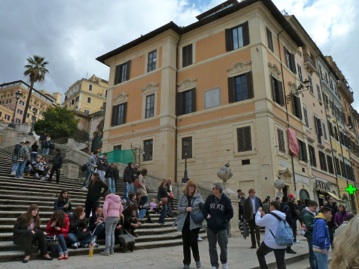
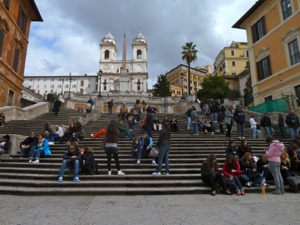
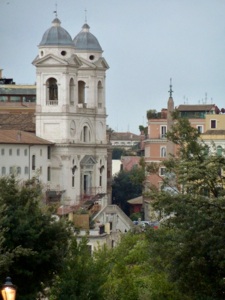
Designed in 1717 to link the (French) Trinita dei Monti church at the top of the stairs to the Spanish embassy below, both being under the influence of Bourbon kings at the time.
The corner house (below) is where Keats and Shelley lived.
THE PIAZZAS
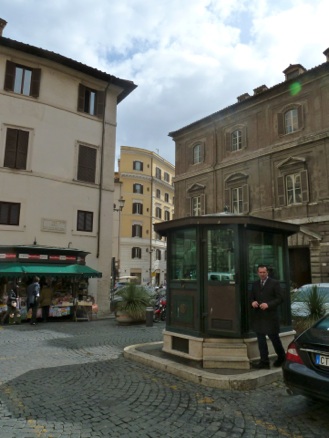
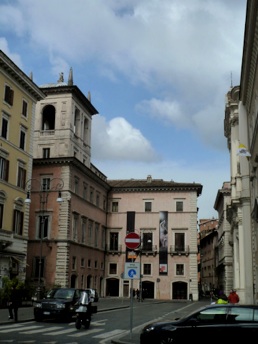
It soon becomes evident that you need to know your piazzas to navigate a path with any destination. Just when you think you’ve knotted your way into a bind, you’ll turn a corner that opens out into a piazza—a topographical oasis in the City of Curtains.
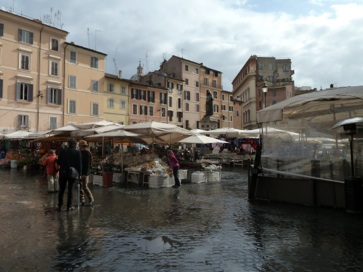
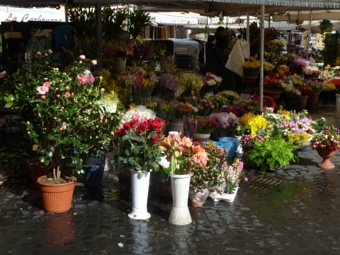
Campo de’ Fiori
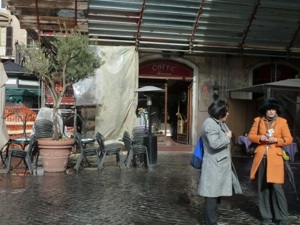
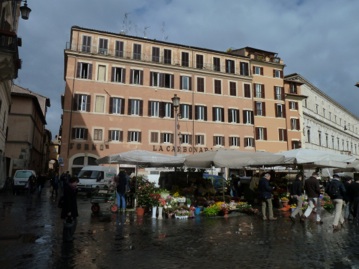
The Piazza Farnese once formed part of a larger area, unused until the 15th century, the Campo de’ Fiori, meaning “field of flowers.” It was a flood-prone meadow that lay between the Pompey Theatre and the Tiber.
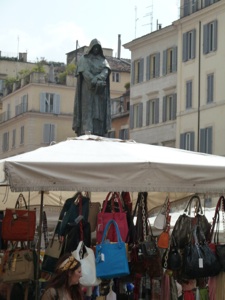
The square emerged without any grand design, becoming literally a commercial crossroads. Each street that runs off of it is named for a trade: Via dei Cappellari (hat-makers), Via dei Chiavari (key-makers), Via dei Giubbonari (tailors). Via Florea and Via Pellegrino were later additions. The grim hooded figure is a statue of Giordano Bruno, a philosopher who, on Feb. 17, 1600, was burnt alive on this spot by the Roman Inquisition for his thought.
Piazza Navona
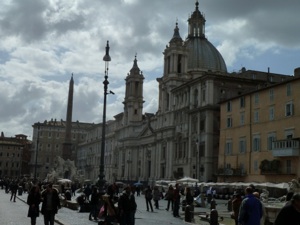
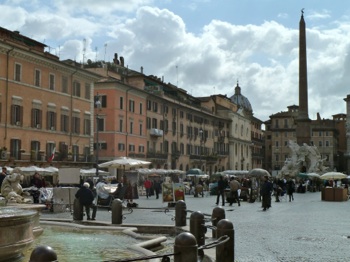
Built on the Stadium of Domitian in 1 A.D., the Piazza Navona follows the stadium’s contours. The central sculpture, Fontana dei Quattro Fiumi, the Fountain of the Four Rivers, was created by the sculptor Bernini.
Galleria Borghese
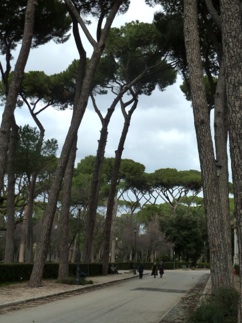
In the middle of this dense metropolis, a property you wouldn’t imagine could survive centuries of urban growth, one of the more beautiful urban parks: the Villa Borghese. The Galleria Borghese houses 6 or 7 paintings by Caravaggio and an impressive collection of Bernini sculpture, featured in a much larger collection of Western painting and Roman sculpture.
All Things Bernini
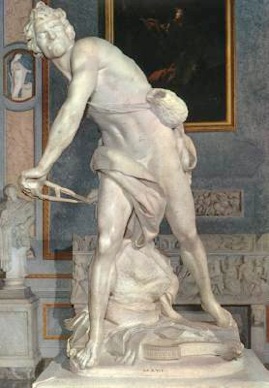
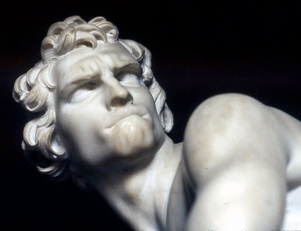
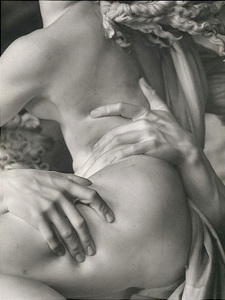
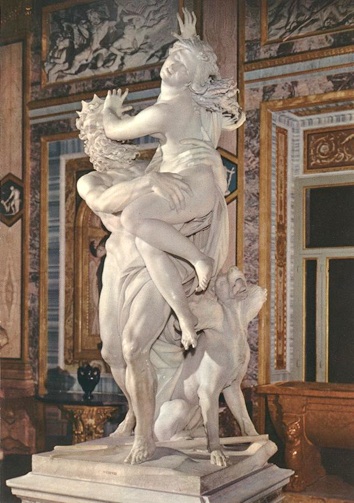
Before this trip, I paid little attention to the work of the Neapolitan sculpture Gian Lorenzo Bernini (1598-1680). When you step into the first decorated room of the gallery, you are confronted with a sculpture unlike no other: Bernini’s Rape of Proserpina (none of the next 4 photos are mine).
Look at that hair, the pleats of her tunic, and the famous impressions in her flesh made by the hands of Zeus himself....or is it Bernini? Bernini is said to be the first to be mindful of the play of light on a sculpture, engaging the effect of shadow or chiaroscuro.
And so ended the first day of “seein’ double.”
For me, compositionally, no one compares. There is a signature style, a sense of the moment, of crisis and climax, of metamorphosis, an almost insane juxtaposition of action and permanence, casting in marble that which is on the verge of perfecting into something else. Like the basket of fruit perched to fall in Caravaggio’s “Supper at Emmaus.”
to Return Home